
Why Great Cafes Start With a Clear Revenue Model, Not Just a Good Menu
Why Great Cafes Start With a Clear Revenue Model, Not Just a Good Menu talks about why great cafes begin with a clear revenue model that defines how the business earns, repeats, scales, and protects margin under real market conditions.
STRATEGY & CONCEPTOPERATIONS & SYSTEMSPROFITABILITY & FINANCE
Paulo Abiog, Coffee & Cafe Business Consultant
5/1/20268 min read
A lot of cafe founders spend months refining the menu before they define how the business will actually make money.
That is one of the most common strategic mistakes in cafe development.
A good menu matters. It influences product appeal, average ticket, speed of service, and brand perception. But a menu alone does not create a viable business. Great cafes do not start with a list of drinks and food items. They start with a clear revenue model.
That distinction matters even more now because the cafe industry is operating in a more demanding environment. FAO reported that world coffee prices rose 38.8% in 2024 due largely to adverse weather and supply-side disruption, and warned that prices could rise further if major coffee-producing regions face more supply reductions. The International Coffee Organization also reported that its Composite Indicator Price averaged 296.89 US cents/lb in January 2026, showing that coffee remains expensive by historical standards.
At the same time, labor costs remain well above historical averages. The National Restaurant Association reported that in 2024, median labor costs were 36.5% of sales for full-service operators and 31.7% for limited-service operators, while median occupancy costs were 5.7% and 5.2% of sales respectively. In a business environment where pre-tax margins are often thin, a strong menu without a clear revenue model is no longer enough.
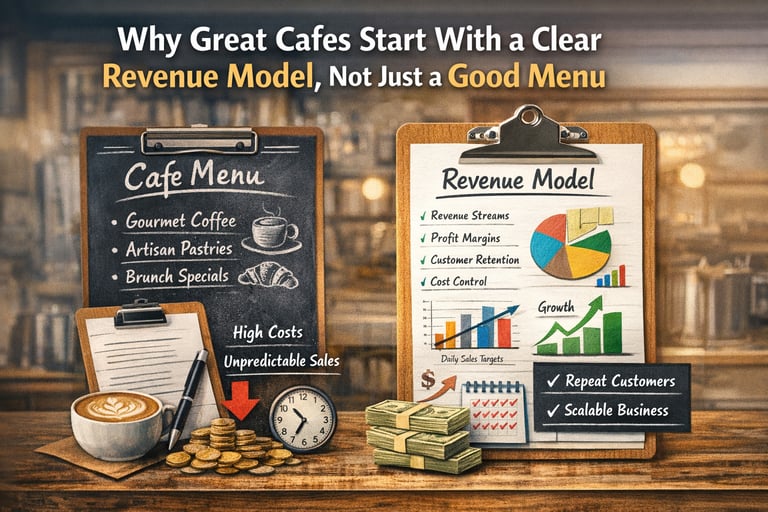
A menu is a product tool. A revenue model is a business tool.
A menu answers what the business wants to sell.
A revenue model answers how the business plans to earn consistently, profitably, and repeatedly.
That means a revenue model should clarify:
What the primary revenue streams are
Which products drive traffic
Which products drive margin
What buying occasions the business is built to win
What level of repeat behavior the model depends on
How the business balances volume, ticket size, labor, rent, and product mix
A cafe with a beautiful menu but no commercial structure often ends up reacting after opening. It adds items to chase sales, discounts to fix slow periods, and new offers to compensate for weak repeat demand. A cafe with a clear revenue model makes more disciplined decisions from the beginning.
The best cafes know where the money actually comes from
A common founder mistake is assuming that revenue comes from “selling coffee.” In practice, revenue usually comes from a mix of categories, occasions, and behaviors.
For some cafes, revenue is driven by:
High-frequency morning beverage transactions
Dine-in food and beverage combinations
Midday meetings and longer stays
Takeaway convenience
Delivery
Retail beans and packaged goods
Events, workshops, or subscriptions
Catering or B2B supply
The right mix depends on the market. But the point is the same: great cafes know which parts of the model attract people, which parts monetize them, and which parts justify the space, labor, and inventory burden.
That is especially important in a market where value competition is intensifying. World Coffee Portal reported that the US branded coffee shop market reached $58.5bn and more than 45,200 outlets, but operators are facing an increasingly difficult trading environment because of record green coffee costs, tariff pressures, and weaker consumer confidence. In the UK, the branded coffee shop market reached £6.1bn and 11,456 outlets in 2025, with many operators focusing more heavily on value-for-money because consumers have more choice. Europe’s branded coffee shop market also grew 4.7% to 51,042 outlets in 2025, but operators reported growing concern over record green coffee prices and high operating costs.
In other words, great cafes are not just trying to serve good products. They are trying to serve the right products in the right revenue structure.
A good menu can still hide a weak business model
Some menus look impressive but are structurally weak.
That usually happens when the menu is built around creativity or image instead of commercial discipline. The offer may be broad, exciting, and visually strong, but still fail to answer critical business questions:
Is the menu too labor-heavy?
Does it slow service too much?
Does it rely on items with weak margin?
Does it fit the actual traffic pattern?
Does it support repeat purchase?
Does it justify the rent and seating model?
A cafe can sell good coffee and still struggle because the business model underneath it is unclear.
A Realistic Scenario
A founder builds a menu around premium beverages, detailed customization, and food items that look attractive on social media. The concept wins attention early, but the menu slows production, raises labor demands, increases wastage, and weakens consistency. Sales may still come in, but the business works harder than it should for every dollar of revenue.
That is not a menu problem alone. It is a revenue-model problem.
Revenue models should be built around buying occasions
The strongest cafes do not only know what they sell. They know why customers buy.
A commuter buys speed and familiarity.
A remote worker buys space and dwell time.
A neighborhood regular buys routine.
A social customer buys atmosphere and shared consumption.
A convenience-led customer buys low-friction access.
These occasions shape revenue more than menu categories alone.
A clear revenue model starts by identifying which buying occasions matter most in the market, then aligning:
Service flow
Menu architecture
Pricing
Staffing
Operating hours
Format
Add-on opportunities
This is where many cafes become more resilient. Instead of treating the menu as the center of the business, they treat customer behavior as the center and let the menu support it.
Great cafes are designed around revenue mix, not just item mix
A menu tells you what products exist. A revenue model tells you how revenue is distributed.
That means operators should understand:
Which products bring first-time trial
Which products create habit
Which products improve average ticket
Which products protect margin
Which products create labor drag
Which products occupy too much space for too little return
This is especially important when costs remain elevated. The National Restaurant Association noted that labor costs in 2024 stayed well above historical averages, and profitable operators were more likely to keep labor costs under tighter control than those operating at a loss.
In practical terms, that means great cafes cannot afford to build menus without understanding how each category contributes to revenue quality.
A revenue model forces better decisions about format
The moment a business gets serious about its revenue model, format decisions become clearer.
A cafe that depends on:
Rapid morning volume
Fast repeat beverage purchases
Low-friction ordering
High transaction count
may need a different format from one that depends on:
Longer dwell times
Food attachment
Second beverages
Social usage
Weekend destination traffic
A multi-revenue model may make sense when the market can support multiple streams such as dine-in, takeaway, retail, delivery, or events. A grab-and-go model may make more sense when speed and routine dominate. A dine-in model may make more sense when the market supports longer stays and higher basket size.
Revenue logic should shape the format, not the other way around.
Strong revenue models reduce dependence on hope
A weak cafe model often depends on hope.
Hope that customers will stay longer.
Hope that premium pricing will be accepted.
Hope that enough people will add food.
Hope that slow periods will somehow fill themselves.
A strong revenue model replaces hope with structure.
It clarifies:
How many daily transactions are needed
What average ticket is realistic
Which day-parts matter most
What percentage of sales should come from beverages, food, or add-ons
What role retail or off-premise channels should play
What level of repeat purchase the business needs
This becomes especially important when site economics are tight. CBRE’s 2025 retail rent report notes that prime urban districts still command premium rents, but performance varies sharply by corridor, and live-work-play districts are outperforming in many places because they align better with how people spend time and seek convenience. That means the revenue model has to fit not only the menu, but also the area and the cost structure of the site.
Investors and partners back revenue logic, not just product appeal
A good menu may make a business look interesting. A clear revenue model makes it look investable.
Investors and partners want to understand:
What drives demand
What drives margin
Whether revenue is too dependent on one daypart
Whether the model can scale
Whether the business is too reliant on one product category
Whether revenue can hold under higher costs or weaker traffic
This matters in the current market because growth and cost pressure are happening at the same time. World Coffee Portal’s 2025 reporting shows that major branded markets continue to expand, but operators are increasingly facing value pressure, higher costs, and tougher competition. Businesses that cannot explain how revenue is earned and protected will look far weaker than those that can.
What a clear revenue model should answer
Before finalizing a menu, a serious cafe business should be able to answer these questions:
What is the primary revenue engine?
Morning beverage volume, dine-in food attachment, destination traffic, retail, delivery, or a combination.
Which products drive traffic and which drive margin?
These are not always the same.
What buying occasions are we built to win?
Rush, dwell, meetings, takeaway, weekends, or all-day hybrid use.
How much revenue depends on repeat customers?
And what makes them return.
What is the expected revenue mix?
Beverages, food, retail, catering, subscriptions, or other channels.
What happens if one stream under-performs?
A resilient business should not collapse if one category softens.
Can the labor model support the menu?
Revenue quality matters as much as revenue volume.
The biggest mistake founders make
The biggest mistake is treating menu development as strategy.
It is not.
A menu is part of strategy, but it cannot replace a clear commercial model. Founders who begin with products and only later think about revenue often end up with businesses that look strong but behave weakly.
A strong menu without a strong revenue model creates:
Weak pricing discipline
Fragile margins
Reactive promotions
Wasted labor
Slow service
Confused format decisions
Poor scalability
Great cafes do not just ask, “What should we serve?”
They ask, “How does this business actually earn?”
Final Thought
Why do great cafes start with a clear revenue model, not just a good menu?
Because menus do not pay rent.
Revenue models do.
Menus do not control labor.
Revenue models do.
Menus do not explain repeat behavior, daypart dependence, or margin resilience.
Revenue models do.
In today’s environment, where coffee prices remain elevated, labor costs are still above historical norms, and occupancy continues to pressure margins, great cafes need more than good products. They need commercial clarity.
A good menu can make a cafe attractive.
A clear revenue model is what makes it work.
Summary
Great cafes start with a clear revenue model because a menu alone does not explain how the business earns consistently, protects margin, or scales under pressure. A strong revenue model identifies the main revenue engines, the buying occasions the cafe is built to win, the products that drive margin versus traffic, and the revenue mix needed to support rent, labor, and repeat demand. This is more important now because coffee prices remain elevated, labor costs are still above historical averages, and operators face stronger value competition across major markets. The best cafes do not only know what they sell. They know how the business earns, repeats, and survives.
Key Takeaway
A good menu can attract customers, but only a clear revenue model explains how the cafe will earn reliably, protect margin, and remain viable under real market conditions.
Frequently Asked Questions
What is a revenue model in a cafe business?
A revenue model explains how a cafe earns money consistently. It covers primary revenue streams, buying occasions, product mix, repeat demand, pricing logic, and how the business supports margin.
Why is a good menu not enough to build a great cafe?
Because a menu shows what the business wants to sell, but not necessarily how it will earn sustainably. A strong menu without a clear revenue model can still create weak margins, labor inefficiency, and poor repeatability.
What should come first, the menu or the revenue model?
The revenue model should come first. It creates the commercial logic that the menu should support.
What are examples of cafe revenue streams?
Cafe revenue streams can include dine-in beverage sales, food, takeaway, retail beans, packaged products, delivery, catering, events, subscriptions, or wholesale.
Why does revenue mix matter in a cafe?
Because not all products contribute equally. Some drive traffic, some drive margin, and some create labor or inventory drag. Understanding the mix improves decision-making.
Why is a clear revenue model more important now?
Because coffee costs remain elevated, labor costs are still above historical norms, and competitive pressure around value has increased in major markets. A weak model becomes harder to absorb.
References
FAO, Adverse climatic conditions drive coffee prices to highest level in years.
International Coffee Organization, January 2026 public market information and Composite Indicator Price.
National Restaurant Association, Restaurant labor costs are well above historical averages.
National Restaurant Association, Restaurant occupancy costs were more than 5% of sales in 2024.
National Restaurant Association, Elevated labor costs had a significant impact on restaurant profitability in 2024.
World Coffee Portal, Growth slows in $58.5bn US branded coffee shop market amid unprecedented cost pressures.
World Coffee Portal, Value in the spotlight as competition heats up in £6.1bn UK branded coffee shop market.
World Coffee Portal, Fastest growth in five years for the European branded coffee shop market.
Planning a new cafe, refining your concept, or trying to improve profitability?
Start by clarifying how the business is designed to earn, not just what it wants to serve.
Or email directly at hello@consultnow.me