Why Branding is more than Logos in the Cafe Business
Why Branding is more than Logos in the Cafe Business talks about that, in the cafe business, branding is not just visual identity. It is the commercial meaning customers attach to your business, and it shapes pricing power, repeat behavior, trust, and long-term competitiveness.
STRATEGY & CONCEPTOPERATIONS & SYSTEMSBRAND & MARKET POSITIONINGPEOPLE & SERVICE CULTURE
Paulo Abiog, Coffee & Cafe Business Consultant
5/6/20267 min read
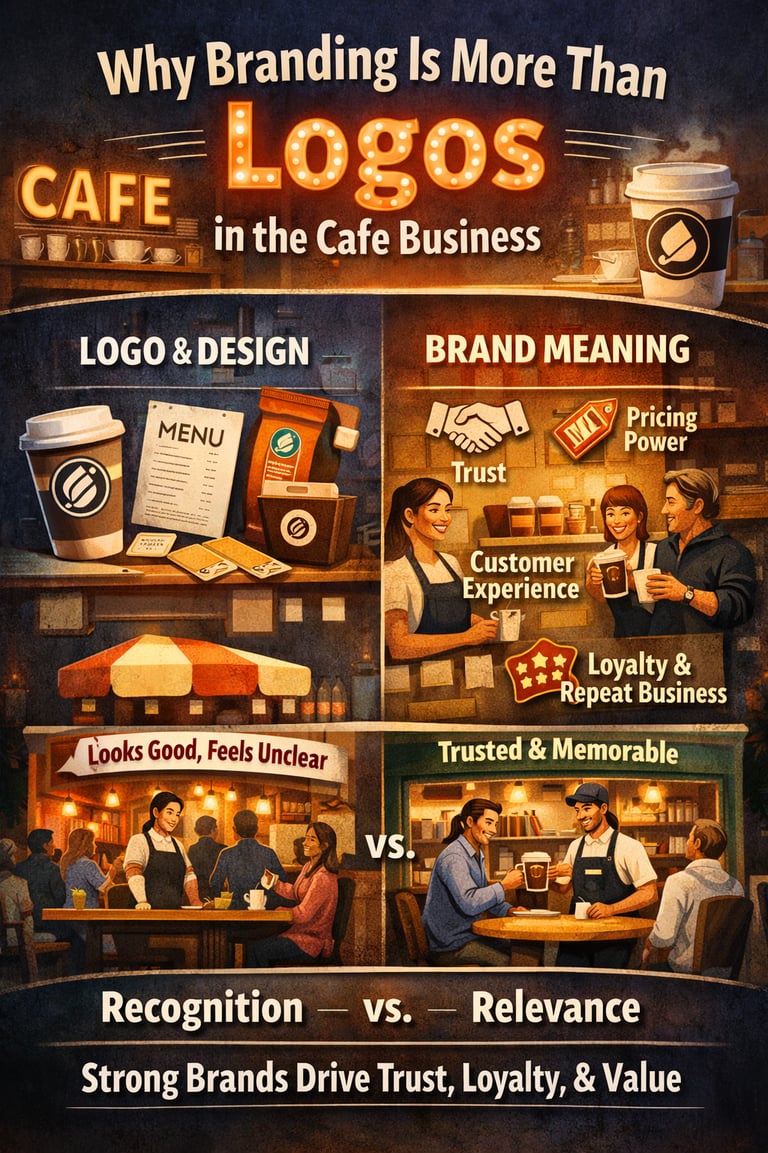
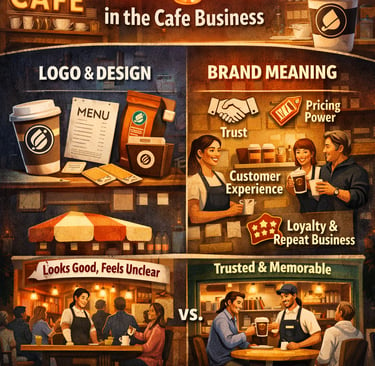
In the cafe business, branding is not just visual identity. It is the commercial meaning customers attach to your business, and it shapes pricing power, repeat behavior, trust, and long-term competitiveness.
A lot of cafe founders still treat branding as a design exercise.
They focus on the logo, the color palette, the cups, the menu layout, the interior details, and the Instagram feed. Those things matter. But they are not the full meaning of branding, and they are rarely enough on their own to make a cafe commercially strong.
In the cafe business, branding is not just what the customer sees. It is what the customer understands, expects, remembers, and repeats.
That distinction matters more now because coffee and cafe businesses are operating in a market where costs remain elevated and customer choice is wider than ever. FAO reported that world coffee prices rose 38.8% in 2024 due largely to adverse weather and supply-side disruption, while the International Coffee Organization said its Composite Indicator Price still averaged 296.89 US cents/lb in January 2026. At the same time, operators continue to face elevated labor and occupancy pressure, making it harder for weak brands to hide behind attractive design alone.
In that environment, branding becomes a business issue, not just a creative one.
Branding is how the market interprets the business
A logo is a symbol. A brand is the meaning attached to that symbol.
For a cafe, that meaning is built through:
The type of customer the business attracts
The quality level the customer expects
The reason customers choose it over alternatives
The consistency of the experience
The tone of service
The perceived value of the offer
The trust the business earns over time
That is why two cafes can sell similar drinks at different prices and get very different customer responses. The difference is not only product. It is what the brand has taught the market to believe.
A strong cafe brand helps the customer answer a few questions quickly:
Who is this place for?
What is it known for?
What kind of experience should I expect?
Why is it worth this price?
Why should I come back?
If the business cannot answer those questions clearly, the branding is incomplete, no matter how polished the visuals are.
Weak branding creates commercial confusion
One of the biggest branding mistakes in the cafe business is visual polish without commercial clarity.
The store may look premium, but the menu may feel generic. The content may look sophisticated, but the customer experience may feel inconsistent. The business may try to speak to everyone at once, which means it becomes memorable to no one.
This is where branding becomes expensive. A weak brand does not just look unclear. It quietly affects:
Pricing Power
Conversion
Repeat Behavior
Loyalty
Word-Of-Mouth
Staff Alignment
Investor Confidence
That risk is more serious in a market where competition continues to intensify. In the UK branded coffee shop market, World Coffee Portal reported that operators are focusing more heavily on value-for-money because consumers now have more coffee shop choices than ever before. In the US branded market, operators are facing record green coffee costs, tariff pressure, and lower consumer confidence while competing in a $58.5bn segment with more than 45,200 outlets. In Europe, the branded coffee shop market grew 4.7% to 51,042 outlets in 2025, but operators also reported high operational costs and concern over record green coffee prices.
In that kind of environment, unclear branding is not neutral. It makes the business weaker.
Great branding supports pricing, not just perception
A lot of operators assume branding is mainly about looking more premium.
That is too narrow.
Branding matters because it helps justify price. Customers are more willing to accept pricing when they clearly understand what makes the business worth paying for. That does not always mean luxury. In some markets, branding supports premium quality. In others, it supports convenience, speed, trust, or familiarity.
The stronger the brand, the less the business has to rely on discounts to stay relevant.
This matters now because coffee prices remain elevated and many operators are still passing supply chain costs through to consumers. World Coffee Portal reported that in the US, sales growth has been supported in part by higher retail pricing, with average prices for common coffee drinks increasing over the last year as operators respond to soaring commodity costs.
A cafe with weak branding often gets trapped between cost pressure and customer hesitation. It needs to charge more, but it has not built enough value perception to make the market comfortable with that price.
A realistic scenario
Two cafes operate in similar districts. Both use comparable beans, similar equipment, and similar drink menus. One has built a reputation for consistency, clarity, and a customer experience people can describe easily. The other looks attractive but feels harder to define. When prices rise, the stronger brand holds demand more effectively because customers already understand what they are paying for.
That is branding at work.
Branding influences repeat behavior
A customer may visit once because of curiosity, convenience, or marketing.
They return because the brand has made the experience easy to trust.
In a cafe business, repeat behavior usually depends on a combination of:
Product Consistency
Recognizable Value
Emotional Familiarity
Service Tone
Environmental Comfort
Identity Fit
Branding is what ties those things together into something the customer can remember.
This matters because routine is one of the most valuable assets in the coffee business. World Coffee Portal’s UK consumer research found that the share of consumers making multiple coffee shop visits per week increased from 56% to 60% over the last 12 months, while early morning coffee shop activity also rose as office traffic improved. That shows how powerful repeat behavior can be when a cafe fits the customer’s routine and earns ongoing trust.
A great brand is not only noticeable. It becomes habitual.
Branding should shape the entire operating experience
Branding is often misunderstood because founders isolate it in the marketing or design phase.
In reality, branding should shape:
The menu strategy
The service tone
The store format
The product mix
The price architecture
The packaging
The hiring profile
The way complaints are handled
The way quality is maintained
If the business says it is premium but service feels casual and inconsistent, the brand weakens. If the visuals suggest quality but the menu is cluttered and confusing, the brand weakens. If the store claims accessibility and warmth but feels intimidating or slow, the brand weakens.
Branding is strongest when operations and identity reinforce each other.
Strong branding improves decision-making
One of the most useful functions of branding is internal, not external.
A clear brand helps operators make better decisions about:
Which products belong on the menu
What kind of site fits the concept
What level of service is expected
What customer segment to prioritize
What kind of partnerships make sense
How to allocate marketing spend
Without brand clarity, businesses become reactive. They copy competitors, chase trends, widen the menu too quickly, and speak inconsistently across channels.
This is where branding becomes strategic. It helps the business decide not only what to do, but what not to do.
Branding matters to investors and partners too
Branding is not only about customer appeal. It also affects how investors, landlords, suppliers, and strategic partners evaluate the business.
A well-branded cafe business usually signals:
Clearer Market Positioning
Stronger Customer Understanding
Better Pricing Logic
More Consistent Execution
More Scalable Communication
Greater Commercial Discipline
That does not mean investors back aesthetics. It means they are more likely to trust businesses that can clearly explain what the brand stands for, who it is built for, and how that brand identity translates into repeat demand and margin support.
In more competitive markets, that clarity matters more. World Coffee Portal’s market reporting across the US, UK, and Europe shows that operators are not just competing on product anymore. They are competing on value, convenience, format, and distinctiveness in increasingly crowded categories.
Branding is especially important when markets become crowded
A weak market can expose a weak concept. A crowded market exposes a weak brand.
When customers have many similar coffee options, branding becomes the shortcut they use to decide:
Where to try
Where to return
Where to trust price increases
Where to recommend
Where to stay loyal
This is why branding becomes more important, not less, as the market matures.
A logo may help recognition. A strong brand helps preference.
The biggest mistake founders make
The biggest mistake is thinking branding happens after the business model is decided.
In reality, branding and business strategy should develop together.
A founder who treats branding as a finishing touch often ends up with:
A concept that looks better than it performs
Pricing that the market resists
Customer confusion about what the business is
Weak repeat behavior
Inconsistent communication
Poor internal alignment
Branding is not decoration. It is part of the commercial structure of the business.
Final thought
Why is branding more than logos in the cafe business?
Because logos identify.
Brands justify.
Logos make recognition possible.
Brands make preference possible.
Logos can make a business look polished.
Brands help a business earn trust, repeat behavior, and pricing power.
In today’s environment, where coffee prices remain elevated, labor and occupancy costs continue to pressure margins, and customers have more choice than ever, branding is no longer a cosmetic layer. It is one of the clearest ways a cafe protects commercial relevance.
A strong logo can make a cafe visible.
A strong brand is what makes it matter.
Summary
Branding in the cafe business is not just visual identity. It is the total meaning customers attach to the business, and it influences trust, pricing power, repeat behavior, and long-term competitiveness. A strong brand helps customers understand who the business is for, what it is known for, and why it is worth choosing over alternatives. That matters more now because coffee costs remain elevated, labor and occupancy continue to pressure margins, and competition across major coffee markets is intensifying. Great branding is not decoration. It is a strategic tool that helps cafes clarify their value, support pricing, guide operations, and build repeat demand.
Key takeaway
In the cafe business, branding is not only about how the business looks. It is about how clearly the market understands, values, remembers, and repeats it.
Frequently Asked Questions
Why is branding more than a logo in the cafe business?
Because a logo is only one visual element. Branding includes customer perception, value, service tone, product consistency, pricing credibility, and the overall meaning attached to the business.
Does branding really affect cafe profitability?
Yes. Strong branding can improve pricing power, repeat behavior, loyalty, and customer trust, all of which directly affect commercial performance.
Can a cafe have a strong logo but weak branding?
Yes. A cafe can look polished visually but still feel unclear, inconsistent, or forgettable in the market if the overall brand meaning is weak.
How does branding help a cafe compete?
Branding helps customers understand why the business is different, what it stands for, and why it deserves their attention and money in a crowded market.
What parts of a cafe business should branding influence?
Branding should influence menu design, service tone, pricing logic, store format, packaging, marketing, team behavior, and customer experience.
Why is branding more important now?
Because major coffee markets are more competitive, coffee costs remain elevated, and customers are more selective about where they spend. In that environment, unclear brands struggle more quickly.
References
FAO, Adverse climatic conditions drive coffee prices to highest level in years.
International Coffee Organization, January 2026 market information and Composite Indicator Price.
National Restaurant Association, Restaurant labor costs are well above historical averages.
National Restaurant Association, Restaurant occupancy costs were more than 5% of sales in 2024.
World Coffee Portal, Growth slows in $58.5bn US branded coffee shop market amid unprecedented cost pressures.
World Coffee Portal, Value in the spotlight as competition heats up in £6.1bn UK branded coffee shop market.
World Coffee Portal, Fastest growth in five years for the European branded coffee shop market.
Planning a new cafe, repositioning an existing brand, or trying to strengthen pricing and repeat demand?
Start by treating branding as a business system, not just a design project.
Or email directly at hello@consultnow.me