The Real Meaning of Unique Selling Proposition in a Saturated Coffee Market
The Real Meaning of Unique Selling Proposition in a Saturated Coffee Market talks about USP is something meaningfully different that customers understand, value, and act on repeatedly. It changes behavior. It influences choice. It supports pricing. It strengthens repeat business.
STRATEGY & CONCEPTOPERATIONS & SYSTEMSBRAND & MARKET POSITIONINGPEOPLE & SERVICE CULTURE
Paulo Abiog, Coffee & Cafe Business Consultant
5/20/20269 min read
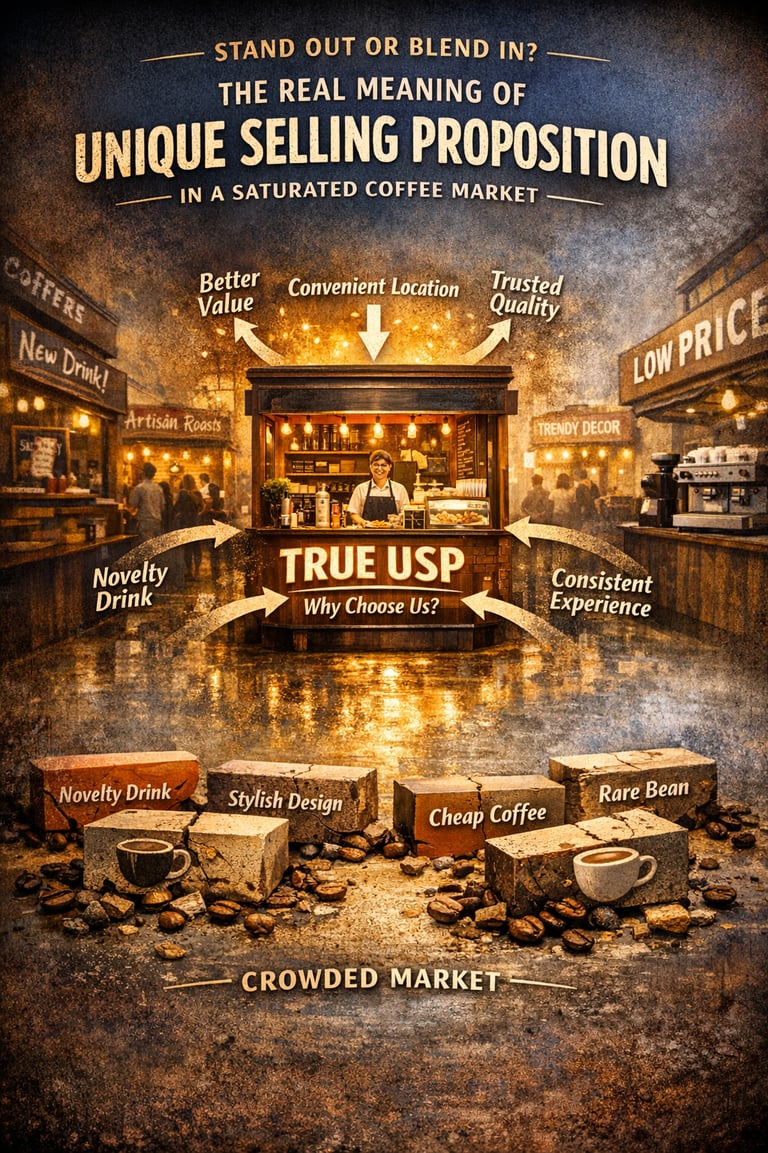
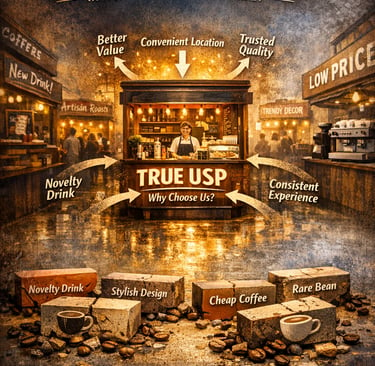
In a crowded coffee market, a real unique selling proposition is not a slogan, a signature drink, or a design style. It is a commercially meaningful reason customers choose your business over other credible alternatives and keep choosing it repeatedly.
A lot of coffee businesses talk about having a unique selling proposition. Very few actually do.
In saturated coffee markets, founders often confuse uniqueness with decoration. They point to a logo, a store design, a signature drink, a roasting story, or a niche ingredient and call it a USP. But in business terms, a real unique selling proposition is not just something different. It is something meaningfully different that customers understand, value, and act on repeatedly. It changes behavior. It influences choice. It supports pricing. It strengthens repeat business.
That distinction matters more now because the coffee business is operating in a more demanding environment. FAO reported that world coffee prices rose 38.8% in 2024 due largely to adverse weather and supply-side disruption, and warned that export prices could rise further if major producing regions face additional supply reductions. The International Coffee Organization also reported that its Composite Indicator Price averaged 296.89 US cents/lb in January 2026, which means coffee remains expensive by historical standards.
At the same time, competition in branded coffee retail remains intense. World Coffee Portal reported that the US branded coffee shop market reached $58.5bn and more than 45,200 outlets, the UK market reached £6.1bn and 11,456 outlets, and the European branded coffee shop market grew 4.7% to 51,042 outlets in 2025. In all three markets, operators are dealing with stronger competition, value pressure, and high operating costs. In that environment, weak positioning becomes expensive very quickly.
A USP is not what makes you look different. It is what makes customers choose you.
The real meaning of a USP is not novelty by itself. It is relevance with commercial force.
A strong USP gives customers a clear answer to one question: Why should I choose this coffee business instead of the other options available to me?
That answer can come from different places:
Better fit for a specific buying occasion
Stronger convenience
Better perceived value
Clearer quality leadership
Stronger hospitality
More relevant atmosphere
More trusted consistency
More useful format for the market
The key is that the difference must matter to the customer, not just to the founder. A business can be original and still commercially weak if the difference does not influence behavior. In a saturated market, being different is easy. Being meaningfully preferable is much harder.
Saturated markets expose weak USPs quickly
A coffee market becomes saturated when customers have many viable alternatives and switching costs are low.
That is exactly why a weak USP gets exposed so fast in coffee. Customers can buy from the next cafe, the next chain, the next kiosk, the next delivery app, or the next workplace machine. If a business cannot make a strong case for why it should be chosen, it becomes easier to ignore. World Coffee Portal’s 2025 reporting on the UK market explicitly notes that operators are focusing on value-for-money because consumers have more coffee shop choices than ever before. Its US reporting also points to a tougher environment shaped by record green coffee costs, tariff pressures, and lower consumer confidence.
In other words, saturation does not merely increase competition. It raises the standard for relevance.
A signature product is not automatically a USP
One of the most common mistakes in coffee is mistaking a featured product for a real proposition.
A signature drink may create curiosity. A seasonal menu may generate attention. A rare bean or creative recipe may make the business look interesting. But none of those is automatically a USP unless it leads to repeatable customer preference.
A real USP should survive beyond first trial. If customers try something once, post it, and then return to their normal routine elsewhere, the proposition was interesting but not structurally strong. In crowded categories, curiosity is not enough. The business needs something that earns repeated choice under normal behavior, not just launch-week interest.
A realistic scenario
A cafe launches with a highly photogenic signature beverage and gets strong online attention. The drink drives initial trial, but most customers do not come back often because the broader experience is similar to surrounding options, the price feels high relative to routine use, and the core buying occasion is unclear.
That is not a bad product problem. It is a weak USP problem.
Real USPs are often rooted in business model fit
In coffee, many strong USPs are less glamorous than founders expect.
They are often built around things like:
Being the fastest reliable option in a commuter corridor
Offering specialty-level quality without intimidation
Being the most trusted neighborhood routine
Creating a better meeting or work environment
Delivering better value at a given quality level
Combining convenience and consistency more effectively than nearby competitors
These are not always dramatic ideas. But they can be commercially powerful because they fit how customers actually buy.
That is especially important in a market where labor and occupancy costs remain elevated. The National Restaurant Association reported median 2024 labor costs of 36.5% of sales for full-service operators and 31.7% for limited-service operators, while occupancy costs were 5.7% and 5.2% of sales respectively. When costs are high and margins are tight, a business needs a proposition that improves revenue quality, not just visual distinctiveness.
A real USP supports pricing power
If customers do not clearly understand why a business is worth its price, the USP is probably weak.
A strong USP helps justify price by connecting the offer to a meaningful advantage. That advantage may be premium quality, exceptional convenience, stronger hospitality, greater consistency, or better value for the money. But it needs to be clear enough that customers feel the difference rather than simply hear about it.
This matters more now because costs remain elevated across the coffee value chain. FAO tied the 2024 coffee price surge to weather stress in Brazil, production declines in Viet Nam and Indonesia, and higher shipping costs. When operators need to protect margins, pricing becomes harder for businesses whose proposition is vague or interchangeable.
A weak USP usually creates pricing tension. The business needs to charge more, but the customer does not fully understand what makes the business worth more.
A real USP should be easy for the market to describe
One of the best tests of a true USP is whether customers can explain it simply.
If people can quickly say:
“That’s the best place for fast, reliable coffee near the station.”
“That’s where I go when I need a calm place to work.”
“That’s the place that feels premium without feeling pretentious.”
“That’s the brand I trust when I want quality every time.”
then the business is getting closer to a real proposition.
If the explanation becomes long, abstract, or overly founder-driven, the USP is probably not landing clearly enough. In crowded markets, clarity matters because customers compare quickly and decide quickly.
Many coffee businesses position around internal pride instead of external relevance
Founders often build around what they personally admire:
Sourcing Story
Design Language
Coffee Philosophy
Equipment
Roasting Approach
Creative Menu Ideas
Those can all matter. But they are not automatically relevant to the customer’s decision.
The strongest USPs are built from the outside in. They begin with market reality:
What does the customer need?
What frustrates them about existing options?
What are they willing to pay for?
What kind of buying occasion dominates this area?
What does this business do better in a way customers can feel?
In saturated markets, internal pride is not enough. The proposition must translate into external preference.
The USP should influence the whole business, not just the marketing copy
A real USP is not a tagline. It should shape:
Site Choice
Service Model
Menu Structure
Price Architecture
Staffing Priorities
Service Tone
Store Layout
Customer Communication
Retention Strategy
If the business claims convenience as its USP, but service is slow and the pickup flow is confusing, the proposition fails. If it claims premium quality, but consistency is weak, the proposition fails. If it claims community, but the atmosphere feels transactional, the proposition fails.
A strong USP becomes part of the operating system of the business. That is why it matters strategically, not just creatively.
A saturated coffee market rewards relevance more than originality
This is one of the hardest truths for founders to accept.
You do not always need the most original concept in the market. You need one of the most relevant ones.
A cafe may not have the rarest bean, the boldest aesthetic, or the most experimental menu, but if it solves a customer need more reliably than others, it may still have a stronger commercial proposition than more visually impressive competitors.
This is also why many hybrid, convenience-led, or accessible-quality concepts are growing strongly. In several markets, consumers want better coffee, but they also want speed, value, clarity, and low friction. Businesses that can combine those more effectively often build stronger repeat behavior than businesses that focus on uniqueness without usability.
What founders should ask when defining a USP
Before claiming a USP, a coffee business should be able to answer these questions clearly:
What customer problem or desire are we solving better than nearby alternatives?
Not in theory, but in daily behavior.
Why would a customer choose us twice, not just once?
Trial and repeat are not the same thing.
Is the difference obvious enough to be felt without explanation?
If not, it may be too weak.
Does the proposition support price?
A strong USP should make pricing easier to justify.
Can the team deliver it consistently?
A proposition that cannot be executed reliably is not bankable.
Does the USP influence operations, not just messaging?
If it only appears in brand copy, it is not yet real.
The biggest mistake founders make
The biggest mistake is thinking a USP means “something no one else has.”
In reality, a better definition is this: a USP is the strongest practical reason your target customer should choose you repeatedly over other viable options.
That may come from uniqueness, but it does not have to. It can come from relevance, clarity, consistency, convenience, value, trust, or better market fit.
In saturated coffee markets, the businesses that win are rarely the ones that are merely different. They are the ones that are different in ways that matter.
Final thought
The real meaning of unique selling proposition in a saturated coffee market is not about standing apart for its own sake.
It is about creating a meaningful commercial advantage customers understand, value, and return to.
In today’s coffee market, where input costs remain elevated, labor costs are still above historical norms, and branded competition continues to expand across major regions, weak propositions get exposed faster and stronger propositions become even more valuable.
A real USP is not just what makes your business look different.
It is what makes your business worth choosing.
Summary
A real unique selling proposition in a saturated coffee market is not just a creative difference or a visual identity cue. It is a meaningful reason customers choose a business over competing alternatives and continue to return. Strong USPs are built around relevance, repeatability, pricing support, and operational consistency, not just originality. This matters more now because coffee costs remain elevated, labor and occupancy still pressure margins, and coffee markets across the US, UK, and Europe continue to grow more competitive. In practice, the strongest USP is the one that customers can feel clearly, explain easily, and repeat often.
Key takeaway
In a saturated coffee market, a real USP is not simply what makes a brand look different. It is what gives customers a clear, valuable, and repeatable reason to choose it.
Frequently Asked Questions
What is a unique selling proposition in a coffee business?
A unique selling proposition is the clearest reason a customer should choose one coffee business over nearby alternatives. It should be meaningful, commercially relevant, and strong enough to influence repeat behavior.
Is a signature drink enough to be a USP?
Not usually. A signature drink may attract trial, but it only becomes part of a true USP if it creates repeatable preference and supports the broader business model.
Does a USP always have to be completely unique?
No. It does not have to be something no one else has. It needs to be a strong and relevant advantage that customers can recognize and value clearly.
Why is USP more important in a saturated market?
Because customers have more alternatives and switching costs are low. In crowded markets, weak propositions are easier to ignore and strong ones are more important for repeat demand.
Can convenience be a USP in coffee?
Yes. Convenience, if delivered better than nearby options, can be a powerful USP. The same applies to quality, hospitality, value, consistency, or atmosphere, as long as the market values it.
How do I know if my USP is real?
A good test is whether customers can explain it simply, feel it clearly in the experience, and behave differently because of it by returning more often or accepting the price more easily.
References
FAO, Adverse climatic conditions drive coffee prices to highest level in years.
International Coffee Organization, January 2026 market information and Composite Indicator Price.
National Restaurant Association, Restaurant labor costs are well above historical averages.
National Restaurant Association, Restaurant occupancy costs were more than 5% of sales in 2024.
National Restaurant Association, Elevated labor costs had a significant impact on restaurant profitability in 2024.
World Coffee Portal, Growth slows in $58.5bn US branded coffee shop market amid unprecedented cost pressures.
World Coffee Portal, Value in the spotlight as competition heats up in £6.1bn UK branded coffee shop market.
World Coffee Portal, Fastest growth in five years for the European branded coffee shop market.
Planning a new cafe, clarifying your position, or trying to compete in a crowded market?
Start by defining a proposition customers can understand, value, and choose again without hesitation.
Or email directly at hello@consultnow.me