Dine-In, Grab-and-Go, or Multi-Revenue Cafe: Which Model Fits Your Market
Dine-In, Grab-and-Go, or Multi-Revenue Cafe: Which Model Fits Your Market discusses that the best cafe model is not the one that looks most attractive on paper. It is the one that fits your market’s traffic pattern, buying behavior, cost structure, and repeat-purchase potential.
STRATEGY & CONCEPTBRAND & MARKET POSITIONINGOPERATIONS & SYSTEMSPEOPLE & SERVICE CULTUREPROFITABILITY & FINANCE
Paulo Abiog, Coffee & Cafe Business Consultant
4/25/20268 min read
A lot of cafe founders start with the wrong question.
They ask, “What kind of cafe do I want to open?”
The better question is, “What kind of cafe will this market support profitably and repeatedly?”
That distinction matters because the choice between a dine-in model, a grab-and-go model, and a multi-revenue cafe is not a branding decision alone. It is a business-model decision. It affects labor, rent, average ticket, speed of service, capital allocation, menu complexity, and the kind of customer behavior the business needs to survive.
That matters even more now because the operating environment remains pressured. FAO reported that world coffee prices rose 38.8% in 2024 due largely to adverse weather and supply-side disruption, and warned that coffee export prices could rise further if major producing regions face additional reductions. The International Coffee Organization said its Composite Indicator Price still averaged 296.89 US cents/lb in January 2026, which shows the category is still operating in a historically elevated coffee-cost environment.
At the same time, restaurant operators continue to deal with elevated labor and occupancy costs. The National Restaurant Association reported that in 2024, median labor costs were 36.5% of sales for full-service operators and 31.7% for limited-service operators, while occupancy costs were 5.7% of sales for full-service and 5.2% for limited-servicerespondents, with urban operators often carrying higher burdens.
In that environment, choosing the wrong format for the wrong market becomes expensive quickly.
The model should follow the market, not the founder’s preference
A good cafe format is not universal. It is contextual.
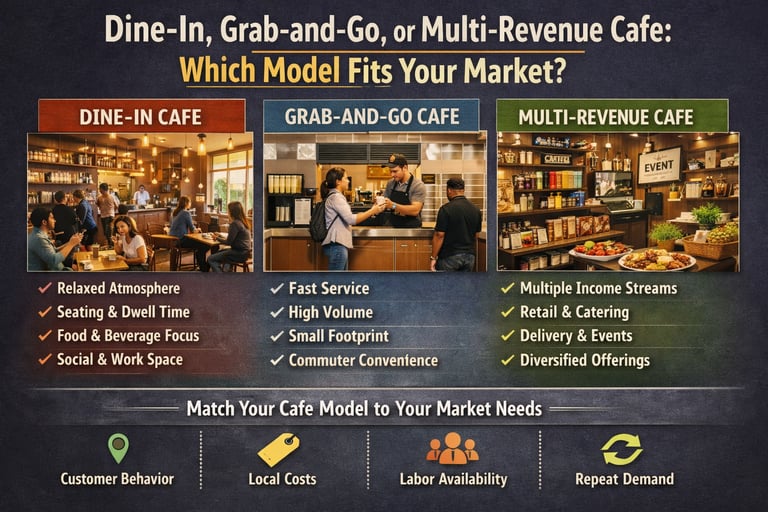
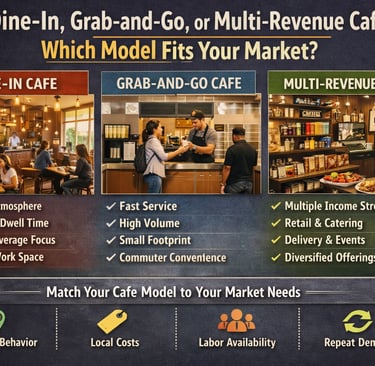
A dine-in cafe depends more heavily on dwell time, atmosphere, seating economics, and a customer base willing to stay, spend, and return for more than convenience. A grab-and-go format depends more on speed, visibility, convenience, and high-frequency routine demand. A multi-revenue cafe depends on the business’s ability to generate income from more than one stream, such as dine-in, takeaway, retail products, events, catering, subscriptions, delivery, or wholesale.
None of these models is automatically better. The right one depends on:
The market’s traffic quality
The dominant buying occasions
Local price tolerance
Rent burden
Labor availability
Repeat-purchase behavior
How broad or narrow the demand really is
That is especially important in coffee markets that are still growing but becoming more competitive. World Coffee Portal reported that the US branded coffee shop market reached $58.5bn and more than 45,200 outlets, but operators face a more difficult trading environment because of record green coffee costs, tariff pressure, and lower consumer confidence. In the UK, the branded coffee shop market grew to 11,456 outlets, but many operators are focusing on value-for-money as competition intensifies. In Europe, the branded coffee shop market grew 4.7% to 51,042 outlets, but operators are also concerned about record green coffee prices and high operating costs.
Growth exists. But so does pressure.
When a dine-in cafe model makes sense
A dine-in cafe model works best when the market supports time spent on-site.
This model usually fits areas with:
Strong residential density
Social meeting behavior
Remote work or informal business meetings
Weekend leisure traffic
Customers willing to stay longer and spend across food and beverage
Lower dependence on ultra-fast throughput
A dine-in model gives the business a chance to increase average ticket through food, second beverages, desserts, and longer stays. It can also strengthen brand loyalty because customers associate the business with atmosphere, hospitality, and routine use.
But dine-in is not automatically more profitable. It usually comes with:
Higher seating and fit-out demands
More space-related rent pressure
More labor coordination
Potentially slower table turns
Greater cleaning and service requirements
A Realistic Scenario
A neighborhood with growing residential density, weekend family activity, and customers who regularly use cafes for meetings or remote work may support a dine-in format well. In that environment, atmosphere and dwell time can become commercial advantages rather than liabilities.
Where dine-in goes wrong
A dine-in model becomes risky when the area is dominated by hurried commuters, limited parking, short dayparts, or price-sensitive buyers who do not spend long enough to justify the space and labor burden.
A full dine-in concept in a site built mainly for transit flow can turn rent and labor into structural disadvantages.
When a grab-and-go model makes sense
A grab-and-go model works best when speed and convenience are the market’s primary needs.
This format usually fits:
Commuter corridors
Office-heavy districts
Transport nodes
Hospital or university-adjacent sites
Business areas with narrow peak periods
Customers who buy routinely but do not want to stay
A grab-and-go model can be operationally efficient because it usually requires:
Less seating
Tighter service flow
Smaller footprints
Faster ticket cycles
Simpler guest interaction
Stronger throughput during peak windows
This can be especially attractive in higher-rent or high-volume locations where every square meter must earn quickly.
World Coffee Portal’s US market coverage highlights the continued strength of drive-thru and convenience-led formats, with growth led in part by operators built around fast, repeatable service. That is a useful signal for markets where customers prioritize convenience over dwell time.
A Realistic Scenario
A site next to offices, transit access, and strong morning footfall may support a compact grab-and-go format far better than a slower, seating-heavy concept. In that case, speed, signage clarity, and repeatable beverage execution may matter more than ambiance.
Where grab-and-go goes wrong
Grab-and-go becomes weak when the market wants a place to stay, meet, work, or socialize. It can also become vulnerable if the area depends too heavily on a single day-part. If revenue is concentrated almost entirely into the morning rush, the format may look efficient but still be fragile.
That is especially risky when labor and occupancy costs remain elevated and there is little room for dead hours.
When a multi-revenue cafe model makes sense
A multi-revenue cafe model works best when the business has a realistic reason to build more than one income stream and the market can support them.
These revenue streams may include:
Dine-in food and beverage
Takeaway
Retail beans or packaged products
Delivery
Catering
Events
Subscriptions
Workshops
Wholesale
B2B coffee supply
This model can be powerful because it reduces dependence on one transaction type or one daypart. If executed well, it can create:
Stronger revenue diversification
Better use of slower periods
Broader customer reach
Improved brand monetization
More resilience when walk-in trade softens
This kind of flexibility can be attractive in volatile environments. If office traffic weakens, retail or delivery may help. If weekend traffic is strong, events or brunch may add upside. If the site is destination-led, merchandise or beans can lift average spend.
A Realistic Scenario
A mixed-use district with weekday office demand, weekend residential activity, strong delivery coverage, and customers open to branded retail may support a multi-revenue format better than a single-channel cafe. In the right market, diversification can improve resilience.
Where multi-revenue goes wrong
The biggest mistake is assuming multi-revenue means “more opportunity” without accounting for complexity.
More revenue streams can also mean:
More SKUs
More training
More inventory complexity
More labor strain
More operational inconsistency
More diluted positioning
A multi-revenue model only works when the systems can support it. Otherwise, the business becomes overbuilt.
How to decide which model fits your market
The strongest format decision usually comes from six questions.
1. What buying occasions dominate the area?
Is the market built around:
Morning commute
Office breaks
Social meetings
Remote work
Weekend leisure
Destination visits
Residential routines
The answer shapes the format more than brand aspiration ever will.
2. What kind of time behavior does the customer show?
Do customers want to stay or leave quickly? Are they browsing, socializing, or just solving a routine need?
A market built around urgency usually rewards grab-and-go. A market built around time and interaction may reward dine-in. A market with mixed behavior may justify multi-revenue.
3. Can the rent support the format?
A seating-heavy model needs enough spend and utilization to justify the space. A smaller footprint may be more suitable if rent is high and traffic is fast-moving.
This matters because occupancy costs remain meaningful, especially in urban locations. The National Restaurant Association’s 2025 operations data showed occupancy costs above 5% of sales in 2024, with urban operators generally carrying more burden.
4. Can the labor model support the concept?
A dine-in or multi-revenue model may require more coordination, more service touchpoints, or more kitchen involvement. A grab-and-go model may be leaner, but still requires strong peak execution.
Labor is still well above historical averages, which means format choices that create unnecessary complexity become more dangerous.
5. Is the market broad enough for diversification?
A multi-revenue model should not be chosen just because it sounds more ambitious. It should only be built if the market genuinely supports multiple buying channels.
6. What is most likely to create repeat behavior?
Repeatability matters more than novelty.
A great-looking cafe that people visit once is less valuable than a well-matched format that becomes routine.
The biggest mistake founders make
The biggest mistake is choosing a format based on image rather than market behavior.
Some founders choose dine-in because they want to build a lifestyle brand.
Some choose grab-and-go because it feels efficient.
Some choose multi-revenue because it sounds more scalable.
All three can fail if the market does not support them.
A dine-in cafe without enough dwell behavior becomes expensive.
A grab-and-go model in the wrong district becomes limiting.
A multi-revenue cafe without the systems to support it becomes chaotic.
The best model is not the most impressive one. It is the one the market can understand, use, and repeat profitably.
Final Thought
Dine-in, grab-and-go, and multi-revenue are not just format labels. They are operating models.
In today’s environment, where coffee prices remain elevated, labor costs are still above historical norms, and occupancy continues to pressure margins, the right format decision matters more than ever.
A dine-in model can work if the market rewards dwell time and spending.
A grab-and-go model can work if speed, convenience, and routine drive demand.
A multi-revenue model can work if the market is broad enough and the systems are strong enough to support it.
The right question is not which model sounds best.
It is which model your market will actually support.
Summary
Choosing between dine-in, grab-and-go, and multi-revenue cafe models is a commercial decision, not only a creative one. Dine-in formats work best where customers stay, socialize, and spend across multiple items. Grab-and-go works best where convenience, speed, and routine buying dominate. Multi-revenue models can improve resilience when the market can support multiple channels and the operator has the systems to manage them. With coffee costs still elevated, labor above historical norms, and occupancy costs still meaningful, the wrong model choice becomes expensive quickly. The best cafe format is the one that matches customer behavior, site economics, and operational capability.
Key Takeaway
The best cafe model is not the most attractive on paper. It is the one whose traffic pattern, spending behavior, cost structure, and operating complexity fit your market.
Frequently Asked Questions
Is dine-in always better for building a stronger brand?
Not always. Dine-in can strengthen brand experience, but it also requires the right customer behavior, rent tolerance, and labor model. In the wrong market, it becomes expensive quickly.
Is grab-and-go more profitable than dine-in?
It can be, but not automatically. It depends on transaction volume, site economics, labor efficiency, and how strongly the market values convenience.
What makes a multi-revenue cafe work?
A multi-revenue cafe works when the market can support more than one income stream and the business has the systems to manage that complexity without weakening execution.
How do I know which model fits my market?
Look at buying occasions, daypart demand, customer time behavior, pricing tolerance, rent burden, and repeat-purchase potential. The model should follow those signals.
Can one model evolve into another over time?
Yes. Many strong operators start with a simpler model, then expand into dine-in or additional revenue streams once demand and systems are proven.
Why is model choice more important now?
Because the industry is operating under higher coffee costs, elevated labor burdens, and meaningful occupancy pressure. A weak model choice becomes harder to absorb.
References
FAO, Adverse climatic conditions drive coffee prices to highest level in years.
International Coffee Organization, January 2026 Coffee Market Report and public market information.
National Restaurant Association, Restaurant labor costs are well above historical averages.
National Restaurant Association, Elevated labor costs had a significant impact on restaurant profitability in 2024.
National Restaurant Association, Restaurant occupancy costs were more than 5% of sales in 2024.
World Coffee Portal, Growth slows in $58.5bn US branded coffee shop market amid unprecedented cost pressures.
World Coffee Portal, Value in the spotlight as competition heats up in £6.1bn UK branded coffee shop market.
World Coffee Portal, Fastest growth in five years for the European branded coffee shop market.
Planning a new cafe, refining your concept, or deciding whether your market needs dine-in, speed, or diversification?
The strongest format choice starts with customer behavior, cost reality, and repeat demand, not preference alone.
Or email directly at hello@consultnow.me